



Discover Gemstream
Scroll gaming news

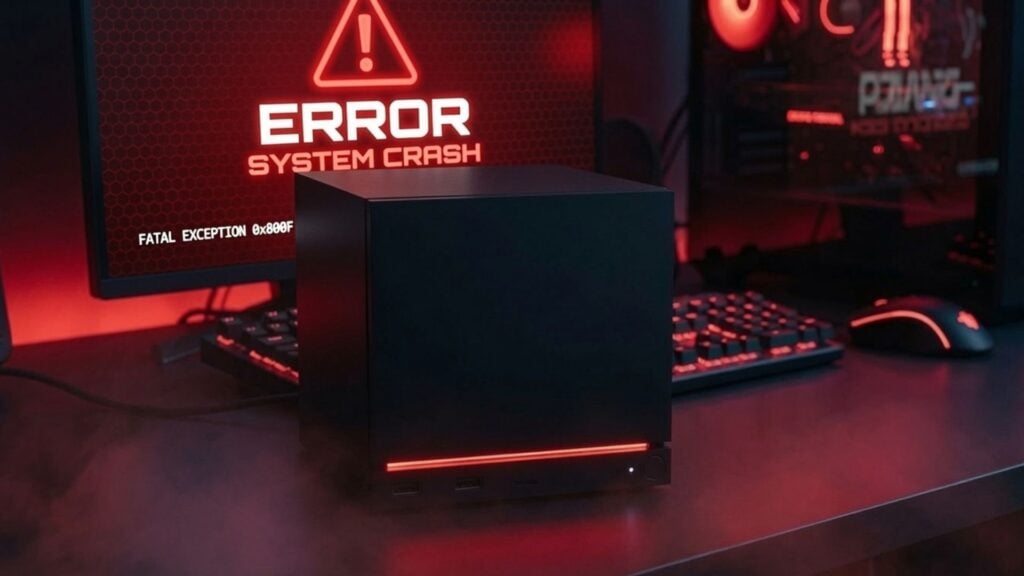
The worst-case scenario for a console launch just hit the Steam Machine from Valve. A Red Line of Death has already surfaced barely days into the first shipping wave.
The Reddit user me_hill posted their story on the r/steammachine subreddit within hours of the incident. The timeline is precise with 5 minutes of No Man’s Sky running fine before a mandatory system update installed. The Steam Machine then stopped putting out any video signal and lit up with the Red Line of Death on its front LED bar. The thread has already racked up over 3,000 upvotes and 500 comments in the dedicated subreddit.
The displayed LED code matches a pattern documented in Valve‘s official support materials. A red right-half breathing pattern combined with a solid red indicator LED signals a GPU failure detected by the system. The official guide lists several other red patterns tied to SSD, memory or overheating issues. No other LED pattern flags a GPU failure on the Steam Machine.
The community immediately dubbed this code the Red Line of Death in a direct nod to the Xbox 360‘s notorious Red Ring of Death. The parallel with the PlayStation 3‘s Yellow Light of Death also came up in the comment threads. These historical nicknames represent industrial nightmares Valve was hoping to sidestep at launch. This marks the first publicly reported failure since the shipping wave started on June 29.
A physically dead GPU on a brand-new Steam Machine raises several technical red flags. No Man’s Sky on moderate settings does not push the component hard enough to actually damage it. The custom AMD silicon in the Valve cube is built to handle far heavier loads without breaking a sweat. A component dying after 20 minutes of light gameplay stays statistically rare on this type of hardware.
The timing of the crash points to a much more credible software explanation. A firmware or interrupted SteamOS update can corrupt the boot process itself. The system then fails to initialize the GPU on startup and throws the same error code as a real GPU failure. This scenario stays fixable through the official recovery mode with no physical intervention needed.
The technical distinction really matters for this user and for anyone else down the line. The GPU on the Steam Machine is soldered directly to the motherboard and cannot be swapped like on a regular PC. An actual GPU failure forces a full return to Valve for reballing or a motherboard replacement. The 12-month warranty covers this kind of incident but the turnaround time stays anyone’s guess for now.
The Steam Machine sells for 1,049 dollars in its base configuration and 1,349 dollars in the 2TB version. This price tag has already drawn public criticism from Shuhei Yoshida, former head of PlayStation Studios, in a recent review. The PC crowd points out that a comparable custom build sits well below that figure with a bit of patience. The global RAM and SSD shortage officially explains the jump from the 449 dollars starting price of the original 2015 model.
A console launch demands a bulletproof software pipeline from day one, no exceptions given. Valve rolled out critical updates just days after the official retail units started arriving in homes. A single reported brick does not yet establish a pattern but stays a serious warning shot. The studio has to prove its updates cannot turn a Steam Machine into a dead paperweight overnight.
The response from Steam Support on this specific case says a lot about Valve‘s industrial maturity. A quick RMA reassures the wave of buyers currently receiving their own units. A slow turnaround feeds the narrative that the Steam Machine is not yet ready for mainstream living rooms. This Red Line of Death must not become Valve‘s first mainstream consumer scandal.
Scroll gaming news
Salut ! Moi c'est Barnabé, l'assistant gaming de RetroGems ! Pose-moi tes questions sur les jeux vidéo, les actus ou le contenu du site. Miaou ! 🎮
Tapez pour rechercher
Comments
Log in to comment
Continue with GoogleBe the first to comment on this article!