



Discover Gemstream
Scroll gaming news

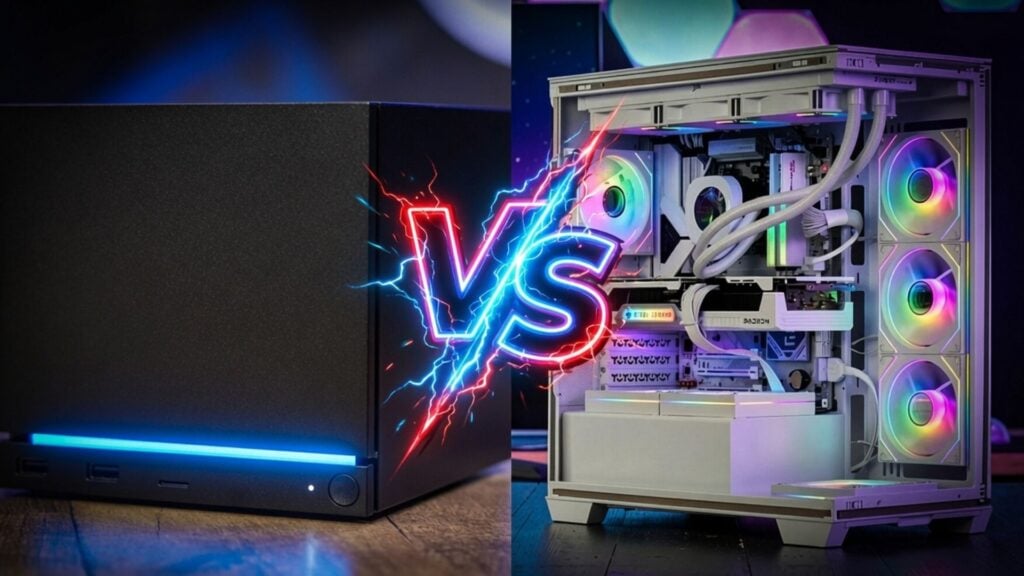
Valve dropped the official Steam Machine pricing on June 22, 2026, with the base model starting at $1,049. At that price point, here’s the matching DIY PC build pieced together part by part. The verdict reveals which one delivers more bang for the buck.
Valve is rolling out 4 configurations for the Steam Machine launch on June 30, 2026. The base 512 GB model opens the slate at $1,049, but ships without a controller. The Steam Controller 2 retails on its own for $99, or bundles in to bring the 512 GB to $1,118. Storage upgrades take the 2 TB version to $1,349. The full 2 TB + Steam Controller 2 bundle tops the lineup at $1,428. Preorders run on a random-draw lottery system closing on June 25, 2026 at 10 AM PT.
Inside the cube sits a semi-custom AMD Zen 4 processor with 6 cores and 12 threads boosting up to 4.8 GHz. The graphics side runs on an AMD RDNA 3 chip packing 28 compute units clocked at 2.45 GHz. Memory pairs 16 GB of DDR5 for the system with a dedicated 8 GB of GDDR6 for the GPU. That memory layout borrows straight from current-gen consoles. The whole package fits inside a 156 mm cube weighing 2.6 kg. SteamOS 3 comes preinstalled with a Windows 11 option available out of the box.
Valve points to the global memory chip crisis to justify these tags. The spike in DDR5 and high-speed SSD costs pushed the final price up. Unlike Sony or Microsoft, Valve does not sell its hardware at a loss and runs on a thin margin only. Valve engineer Yazan Aldehayyat told Eurogamer the final price came in significantly higher than the original 2023 plan.
To match the Steam Machine entry-level specs, here is the DIY build to put together part by part:
The grand total clocks in at around $970 without an operating system, riding SteamOS for free on the custom build. Tacking on a Windows 11 Home OEM license pushes the bill up to roughly $1,110. The Windows-free PC ends up $79 cheaper than the 512 GB Steam Machine. The Windows build lands at $61 above Valve’s price tag.
A few technical advantages still pop up right out of the gate. The Radeon RX 7600 packs 32 compute units against the Steam Machine’s 28 CUs, so the discrete GPU comes in slightly more muscular. The NVMe 1 TB doubles the storage capacity of Valve’s entry model. The mATX case keeps expansion slots free for future upgrades. The global memory chip crisis has driven DDR5 and NVMe SSD prices up sharply. The DIY PC still holds a slim budget edge without Windows.
Both the Steam Machine and the DIY PC bring their own strengths to the table.
On pure bang for the buck, the DIY PC edges out the win. Its upgrade flexibility and $79 entry-level saving without Windows give it a small but real advantage. The Steam Machine keeps the edge on all-in-one packaging and SteamOS optimization, and even pulls level once Windows enters the equation. For a buyer planning 5 years of upgrades, the DIY PC stays the more cost-effective pick.
Scroll gaming news
Salut ! Moi c'est Barnabé, l'assistant gaming de RetroGems ! Pose-moi tes questions sur les jeux vidéo, les actus ou le contenu du site. Miaou ! 🎮
Tapez pour rechercher
Comments
Log in to comment
Continue with GoogleBe the first to comment on this article!